


Music dedication in hard rock: meaning and emotional impact
- Travis B
- May 2
- 10 min read

Many fans assume that when a hard rock or metal band dedicates a song to someone, it’s just a quick shout-out from the stage. A name mentioned before the first chord hits. Simple, clean, done. But that picture couldn’t be further from the truth. Dedication in hard rock and metal) often embeds emotional depth in lyrics inspired by personal stories, losses, relationships, and raw human experience that can take years to fully understand. This guide is going to pull back the curtain on what true dedication really means in this genre, how artists craft it, and why it connects with fans in ways that go far beyond any casual mention.
Table of Contents
Key Takeaways
Point | Details |
Dedications deepen emotion | Music dedications draw from real stories, giving songs personal and relatable impact. |
Blending story and symbolism | Artists mix personal experience with universal themes for depth and authenticity. |
Fans connect through vulnerability | Dedications reveal the artist’s human side, inviting fans into shared experiences of grief, love, or resilience. |
Not all dedications are obvious | Many dedications are disguised in narrative or myth, rewarding careful listening and research. |
Timelessness over trends | Authentic dedications help songs endure beyond fleeting trends thanks to genuine emotional resonance. |
What is music dedication in hard rock and metal?
Now that we’ve set the stage for how powerful dedications can be, let’s clarify exactly what music dedication means and its role in hard rock and metal.
Music dedication in this genre is not a simple act. It’s not just saying “this one’s for my buddy who passed.” In metal and hard rock, dedication is tied to personal stories) and emotional resonance that get woven directly into the fabric of the song itself. The lyrics carry the weight. The arrangement echoes the feeling. The whole song becomes the tribute, rather than just announcing one.
In other genres, a dedication might be a brief liner note or a stage announcement. In metal, it tends to go deeper. The song is constructed around the emotional truth of the experience. You can think of it as the difference between writing someone’s name on a card versus writing them a ten-page letter about exactly what they meant to you.
Understanding why emotion in metal music matters is a big part of understanding dedication. When you hear a guitarist sustain a note that seems to cry out, or when a vocalist’s voice breaks slightly on a particular line, that is often intentional. That’s craft meeting vulnerability.
Here’s a quick comparison of how dedication works across genres:
Genre | Common form of dedication | Emotional depth | Longevity |
Pop | Liner note or stage mention | Surface level | Fades quickly |
Country | Narrative lyric, often explicit | Moderate | Moderate |
Hard rock/metal | Embedded in structure and lyrics | Deep and complex | Often enduring |
Classical | Program note or dedication plaque | Formal, restrained | Historical |
Some common misconceptions about metal dedications worth clearing up:
They’re always about death. Not true. Dedications cover love, loss of friendship, mental health struggles, and philosophical reckoning.
They’re always explicit. Many of the most powerful dedications are never publicly named. Fans piece them together over years.
They’re separate from the music. In great metal, the dedication and the song are inseparable.
“A true dedication in metal is when the entire song becomes the tribute. You don’t just hear a name. You feel a life.”
That’s the standard we hold ourselves to at Winter Agony. When we write from personal experience, the story lives inside every riff, not just in the chorus.
How artists channel personal stories into dedications
With a clear understanding of what dedication means, it’s important to explore exactly how artists translate raw experience into the kind of dedications that move entire audiences.

The sources of inspiration are wide. Steve Harris of Iron Maiden draws from philosophy, history, literature, and personal experience) to craft narrative-driven lyrics that feel both intimate and epic. That combination is rare and it’s exactly what separates a song that lasts thirty years from one that gets forgotten after a tour cycle.
Most artists working in this space pull from a few key wells:
Personal loss. The death of a friend, a bandmate, a family member. These experiences rarely leave anyone unchanged, and for songwriters, they demand to be processed out loud.
Relationship grief. Not just romantic endings, but the slow fade of deep friendships, the estrangement of family, the betrayal of trust.
Philosophy and literature. Many metal artists read widely and use historical or literary figures as vessels for personal emotion.
Mental health and inner conflict. This is increasingly visible in lyrics and has been present in the genre since the early days, even when it wasn’t labeled as such.
The trick to making a dedication feel universal rather than self-indulgent is specificity combined with careful anonymizing. When you describe a feeling in exact, sensory detail but leave the person unnamed or described in general terms, you give the listener room to step into the story. They bring their own grief, their own face to attach to the lyrics.
Here’s a breakdown of two common approaches:
Approach | Method | Effect on listener |
Explicit dedication | Names the person, describes events | Creates intimacy, but can feel narrow |
Embedded dedication | Uses symbol, archetype, and theme | Broadens appeal, listener projects own experience |
Pro Tip: If you’re writing a dedication song yourself, write the first draft with every specific detail included. Full name, exact event, exact feeling. Then rewrite it stripping back the identifiers while keeping the emotional precision. That gap between the two drafts is where the universal version lives.
Learning more about expressing emotion in music and how songwriting fuels emotion in hard rock can help both fans and artists recognize these techniques in real time.
Song examples: From personal loss to universal anthems
Understanding the methods artists use allows us to recognize and appreciate real-world examples. Where do we see dedication in action among iconic songs?
Pantera’s “Cemetery Gates”) is one of the clearest cases. The song draws on real grief tied to a friend’s death and broader tragedy, but Dimebag and Phil Anselmo shaped it to hit anyone who has ever stood at a grave and felt the floor drop out from under them. That’s intentional design. They didn’t want a song only their inner circle could feel. They wanted a song for every person who has lost someone and had no idea how to say it.
“Hollow,” also from Pantera, operates similarly. The pain is real and rooted in specific loss, but the language is broad enough that fans across decades have mapped their own stories onto it. That’s not accidental. It’s artistry.
Alice in Chains’ “Black Gives Way to Blue”) takes a different path. It is a direct, emotional tribute to Layne Staley, their late vocalist, written and performed openly by Jerry Cantrell and the surviving members. There’s no ambiguity. The grief is named, the relationship is named, and somehow that directness makes it even more devastating. It works because the vulnerability is total. No armor.
A key statistic worth noting: “Black Gives Way to Blue” debuted at number one on the Billboard Hard Rock Albums chart, showing that raw emotional honesty in a tribute can absolutely connect commercially, not just critically.
Skid Row’s “I Remember You”) offers yet another angle. The band worried the ballad was too emotionally vulnerable for a hard rock audience. They feared it wouldn’t fit the image. It became one of the biggest hits of their career. That should tell every artist something important about their fans.
Some patterns worth noting across these songs:
Dedications that feel personal but sound universal perform best over time
Artists who allow genuine vulnerability often build stronger loyalty than those who project only aggression
The most memorable dedications resist easy interpretation, giving fans room to return with new ears
Pro Tip: When listening to a song you love, search for live recordings from the era it was released. Artists often break down the meaning of dedications in concert introductions that never make it onto the studio record.
Exploring how music shapes life gives you an even richer sense of why these moments land so hard for fans who carry these songs for decades.
Why music dedications resonate deeply with fans
These song examples show dedication’s power, but why do such tributes strike such a nerve? Let’s break down the psychological and cultural connection.
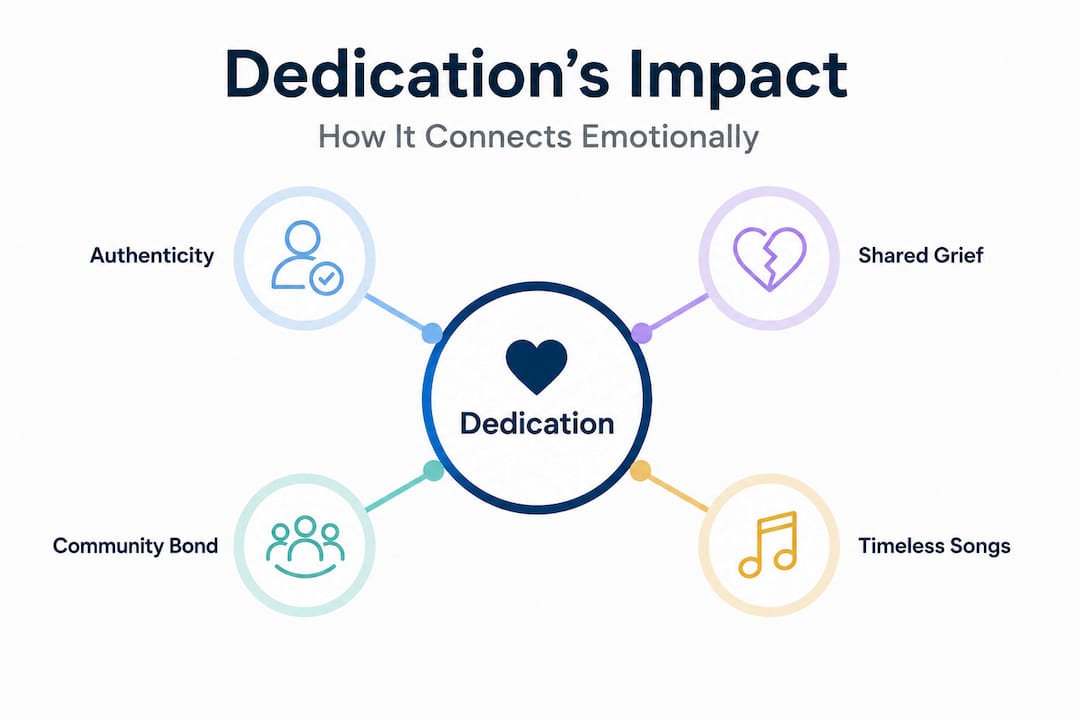
The core answer is catharsis. Fans of hard rock and metal have historically used the genre to process emotions they couldn’t access anywhere else. The loudness creates a kind of permission. In a quiet room, grief can feel embarrassing. At full volume, with a song that names it, grief feels shared, valid, and survivable.
Metal dedications reveal the vulnerability behind sonic aggression), creating authentic fan connections that go beyond entertainment. When a fan realizes that the artist was in actual pain when they wrote a song, something shifts. The music becomes a conversation across time, not just a product.
“When you realize an artist wrote that song on the worst night of their life, and it somehow got you through your worst night years later, that’s not coincidence. That’s why music exists.”
Here’s what makes dedications particularly powerful for metal fans:
Authenticity is everything. Metal audiences have always been sharp detectors of fake emotion. A dedication that feels manufactured gets rejected fast. A real one gets tattooed on someone’s arm.
Community is built around shared grief. When two strangers at a concert both know exactly what a song means and why, a bond forms instantly.
The music validates the struggle. For fans who may have been told their feelings were too intense or too dark, finding a song that says “yes, that’s real” can be genuinely life-changing.
Catharsis through volume. The physical experience of loud music amplifies emotional processing in a way quieter genres simply can’t replicate.
Understanding how to engage rock fans authentically and tap into the emotional power of hard rock are both things we’ve been learning and practicing since Winter Agony started in 2005. Every time we’ve been most honest in our writing, the response from fans has been deepest.
Tips for recognizing and appreciating dedications as a listener
Having explored why dedications matter so much, you may want to sharpen your ability to recognize these moments in the music you love.
Here’s a practical approach to becoming a more engaged listener when it comes to dedications:
Read the liner notes. This sounds old-fashioned but liner notes are where artists often name the people and events directly, without the song having to carry all that weight.
Watch interviews from the release period. Artists are often most candid about the meaning of a song in the months right after an album drops, before the promotional cycle teaches them to stay on message.
Pay attention to lyrical specificity. Vague lyrics are often covering something very specific. When a line feels oddly precise in an otherwise abstract song, that’s often a clue.
Track recurring themes across an album. A dedication rarely lives in one song alone. Often, an artist processes the same grief across three or four tracks on the same record.
Look at the song’s placement on the album. Closing tracks and penultimate tracks are often where the most personal material gets placed, once the emotional armor of the record has done its work.
Metal dedications often blend specific and universal themes) to avoid feeling overly personal or “cheesy,” as some artists describe it, while still achieving genuine emotional resonance. That balance is what fans learn to read with experience.
Pro Tip: Community forums and fan wikis often contain years of research into song meanings that artists themselves have confirmed or hinted at. Sites like Genius have comment threads where fans debate and piece together dedication stories in real detail. It’s worth falling down those rabbit holes.
Why authentic dedications matter more than production polish
To wrap up, here’s a perspective worth considering about what truly makes songs timeless.
We’ve spent time in studios, worked with DAW consoles, obsessed over mixing and mastering. Production quality matters. We’re not here to argue otherwise. But if you stack up the songs that have lasted twenty, thirty, forty years against the ones that haven’t, production quality is rarely the deciding factor. Emotional honesty is.
Songs like “Hallowed Be Thy Name” are acclaimed for their emotional impact and longevity), and that longevity has almost nothing to do with how polished the recording sounds. It has everything to do with what’s being said and how real it feels. Fans can hear the difference between an artist processing something true and an artist performing an idea of emotion.
We’ve seen this up close in our own journey with Winter Agony. The tracks we’ve written from the deepest personal places, the ones we were most uncertain about sharing, those are the ones that generate the most raw responses from fans. Not the technically complex arrangements. Not the songs we spent the most hours in production on. The honest ones.
There’s a lesson in that for every band and every fan. Polish matters, but truth outlasts it every time. The emotional core of metal music has always been its greatest strength, and dedications are where that core gets exposed most completely.
If you’re a musician reading this, prioritize the real story. If you’re a fan, trust your gut when a song feels like it’s telling you something true. Because it probably is.
Explore more stories and connect deeper with hard rock
If this breakdown has you thinking more carefully about the music you love, there’s a lot more to dig into. The stories behind hard rock and metal songs are as varied and human as any literature out there, and we’ve been writing about them here for a while.
Check out our full piece on expressing emotion in music if you want to understand the specific craft techniques artists use to translate internal experience into sound. We also have a deep look at songwriting and emotion in hard rock that gets into the mechanics of how these songs get built from the ground up. Both pieces connect directly to what we’ve covered here and will give you tools to hear your favorite records in a completely new way.
Frequently asked questions
What makes a song a true dedication in hard rock and metal?
A true dedication comes from personal experience or tribute, embedding authentic emotion in the lyrics rather than simply naming someone. As seen across metal’s history, dedication ties to personal stories) and genuine resonance, not surface-level mentions.
Are music dedications always about real people or events?
Not always. Many blend real experiences with fiction, philosophy, or myth to produce broader emotional resonance. Steve Harris and others) regularly draw from philosophy, history, and personal events, often mixing sources within a single song.
How can I tell if a song is a dedication?
Look for clues in lyrics, interviews, and liner notes. Metal dedications blend specifics and universal themes) for authentic resonance, so they may be direct or subtly hidden across an entire record.
Why do artists sometimes avoid explicit dedications?
They often choose ambiguity to prevent songs from feeling narrow or sentimental in a way that alienates listeners. Pantera anonymized personal losses) specifically to avoid that pitfall while keeping the emotional core intact.
Do dedications make songs more successful?
Dedications tend to deepen emotional impact and extend a song’s life well beyond its release cycle. “Hallowed Be Thy Name” endures) partly because of its raw emotional dedication, showing that authenticity often translates into lasting acclaim rather than short-term commercial metrics.
Recommended
Comments